CONECTIA AI DEV PLATFORM · INSTALLED IN 24 HOURS

The AI development platform we install on your codebase in 24 hours

Our own harness and agentic loop. MCP connectors to every service you already use.

THE SHAPE · ONE LOOP

One loop, five agents, four connectors, five gates

Every box is a process with its own tool allowlist, budget and iteration cap.

Conectia AI Dev Platform architecture: JIRA, Confluence, repository and deploy connectors feeding an orchestrator, dev, QA, infra and code-validator agents, with human gates at scope, merge, deploy, irreversibles and decision records
1agentic loop
5specialised agents
4MCP connectors by default
5human gates

Five agents, each with restricted access

Each one runs under an iteration cap, a token budget per ticket and a checkpoint before anything irreversible.

Orchestrator

Writes: the plan only

Reads the ticket and its context, plans the steps and acceptance checks, posts the plan for a human to accept.

Dev agent

Writes: its branch

Implements one step on a branch, runs the tests, opens a pull request. Cannot merge.

QA agent

Separate process

Writes and runs the tests the plan calls for — never the same process that wrote the code.

Infra agent

Prepares, never applies

Environment, CI, infrastructure-as-code. Stages anything that touches production; a person ships it.

Code validator

Read-only · different model

Tries to reject the PR against the plan, the conventions and the security rules. What it passes goes to a human.

An MCP connector for every service

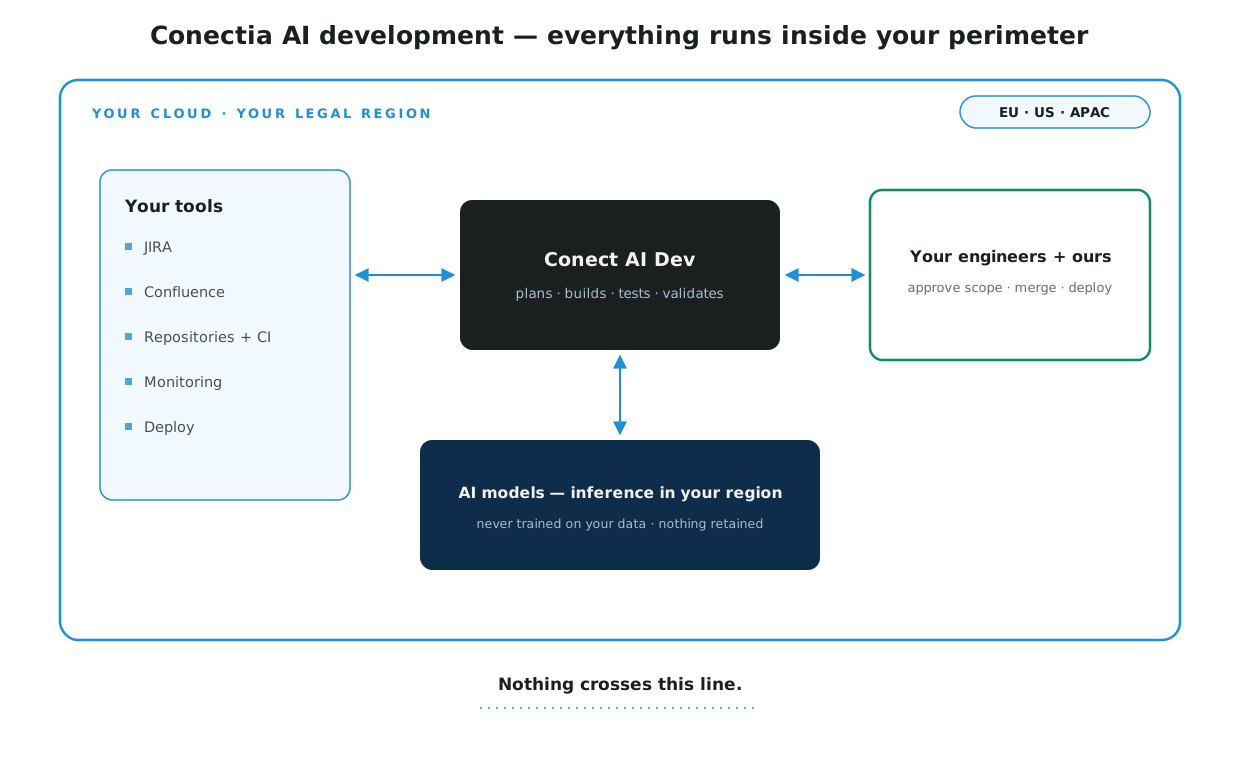
Each connector exposes a small set of typed tools and the agent can call nothing else. Access control lives in the connector, not in a prompt; it runs against your instances with least-privilege credentials, and your engineers own it within weeks.

HUMAN GATES · FIXED

Five points where a person decides.

This is where the engineers we deploy spend their time: reading plans, merging, deciding.

01

Scope

A human accepts the plan before any code is written.

02

Merge

Every pull request is merged by a human, after the validator has passed it.

03

Deploy

Production is a human action on a prepared change.

04

Irreversibles

Schema migrations, data deletion, permissions: the loop stops and waits. No agent has the tool.

05

Decision records

An architecture decision is a draft until an engineer signs it.

What the platform never does: merge to main, deploy to production, change a schema, delete anything, close a ticket.

THE 24 HOURS

It installs in a day because it assumes nothing about your codebase

No particular language, framework or CI vendor. It needs a repository, a ticket tracker, a documentation home and a way to run tests.

1

Hours 0–4 · Inventory and access

Repository, conventions, CI, environments. Least-privilege credentials per connector, reviewed by your CTO.

2

Hours 4–12 · Connectors and conventions

MCP connectors against your instances; your branch naming, commit format, tests and lint in the agents' context.

3

Hours 12–20 · Replay on closed tickets

The loop runs against tickets you already shipped, gates closed. We compare its plans and diffs with what your team did.

4

Hours 20–24 · First live ticket

One real ticket, every gate on, your engineers at each gate with ours beside them.

IS IT FOR YOU

A lot of machinery for a ticket. Here is where it pays.

The platform does not replace the engineer. It removes the parts of the week that were never engineering and puts the engineer at the gates, where judgement is the work.

WHERE IT PAYS
  • A product with paying customers, where a wrong change costs money.
  • A roadmap of dozens of tickets a month.
  • A team that cannot review every diff by hand, and cannot skip the review either.
WHERE WE WOULD NOT INSTALL IT
  • A team of two shipping a prototype.
  • A single ticket a good engineer with a coding assistant would close alone.
  • Anyone looking for «an autonomous developer».

Five questions for any vendor

  1. Where are the gates, and can I add one?A diagram with no humans in it is a no.
  2. What can each agent write to, exactly?Ask for the allowlist per agent, not a description.
  3. Who can change the connectors in six months?If only the vendor, you bought a dependency.
  4. What is the per-ticket budget and who sees it?A loop without a budget is an invoice without a ceiling.
  5. Show me the replay.If it cannot run on your closed tickets first, it was tested on someone else's code.

The platform is not billed separately: it ships with the team, at our published rates. The per-ticket budget is the number your fractional CTO watches most closely — it is the one that turns into an invoice. See the rate card →

A repository, a tracker, docs and a test command? Installed in a day.

Thirty-minute scoping call with a CTO. We start with the inventory.